
Dash cams are widely used in the United States, but two separate legal questions come up over and over: may you record, especially audio inside the car, and where may you mount the camera so it does not break a windshield rule? The answers depend on federal law, on your state’s statutes, and on the facts of the situation. They also change. This article explains the main ideas and points you to official sources. It is not legal advice, and it is not a complete 50-state survey.
If you mainly need placement help, see how to install a dash cam. If you carry passengers and record the cabin, read this first.

Recording video of the road is not the same as recording a conversation
A camera pointed out through the windshield is, in most ordinary driving, recording a scene that is already visible to anyone on the public road. That is different from recording a private conversation inside the car. Wiretapping and eavesdropping laws are mainly about communications that a person reasonably expects to keep private, not about the fact that a lens can see a street.
Audio is the part that gets people into trouble. Many dash cams have a microphone, and some drivers never notice it is on. If you record passengers, a phone call on speaker, or a conversation you are not part of, you may be in the territory of state and federal recording laws. A simple, cautious habit is to know whether your microphone is enabled and to be able to turn it off.
Federal law starts with one-party consent
Federal criminal law generally allows a person to record a conversation if they are a party to it, or if one party has consented, unless the recording is made for a criminal or tortious purpose. That rule appears in 18 U.S.C. § 2511(2)(d). The same statute makes it illegal, in broad terms, to intercept oral, wire, or electronic communications without a recognized exception.
One-party consent does not mean a camera can record every conversation that happens to occur nearby. If you are not a participant, and nobody who is a participant has consented, the federal baseline may not protect the recording. Two passengers talking to each other in the back seat are a common example of that gap.
States can be stricter, and some are
States may require the consent of every party to a conversation, often called all-party or two-party consent. Which states belong on that list, and whether the rule applies to in-person talk, phone calls, or both, is a frequent source of outdated internet tables. A better starting point is a current, cited reference such as the Reporters Committee for Freedom of the Press Reporter’s Recording Guide, plus the statute for the state where you are driving.
Two examples, as written in statute:
- California’s Penal Code makes it a crime, with defined exceptions, to record a “confidential communication” without the consent of all parties. See California Penal Code § 632.
- Florida generally requires the consent of all parties to record certain oral and wire communications, again with statutory exceptions and definitions. See Florida Statutes § 934.03.
Other states have mixed rules — for example, a stricter standard for telephone calls than for in-person speech — or court decisions that affect how a statute is read. If you regularly drive across state lines, the conservative approach is to assume the stricter rule may apply, to give passengers a clear notice that a camera and microphone are present, and to disable audio if you do not need it.
If you use an interior camera for rideshare or delivery work, notice and consent are even more important, and your platform or employer may have its own policy on top of state law.
Windshield mounting: do not obstruct the driver’s view
Mounting rules are traffic-equipment laws, not recording laws. The common idea is that you may not put an object on or in the vehicle in a way that obstructs the driver’s view through the windshield or, in some statutes, the view to the rear. There is no single nationwide dash-cam mounting diagram. Two official examples show how different the details can be.
New York Vehicle and Traffic Law § 375(30) makes it unlawful to operate a motor vehicle with any object placed or hung in or upon the vehicle, except required or permitted equipment, “in such a manner as to obstruct or interfere with the view of the operator through the windshield, or to prevent him from having a clear and full view of the road and condition of traffic behind such vehicle.” The same subdivision limits when a summons for that violation may be issued. The text is in N.Y. Veh. & Traf. Law § 375.
California Vehicle Code § 26708 generally prohibits driving with an object placed on the windshield or with an object that obstructs or reduces the driver’s clear view through the windshield or side windows. The statute then lists exceptions, including limited square-inch areas in certain corners of the glass and a defined “video event recorder” exception with its own conditions — among them, mounting locations, a passenger notice about recording conversations, and a narrow definition of what counts as that kind of recorder. You should read the current text rather than assume every consumer dash cam automatically fits the exception. The official section is California Vehicle Code § 26708.
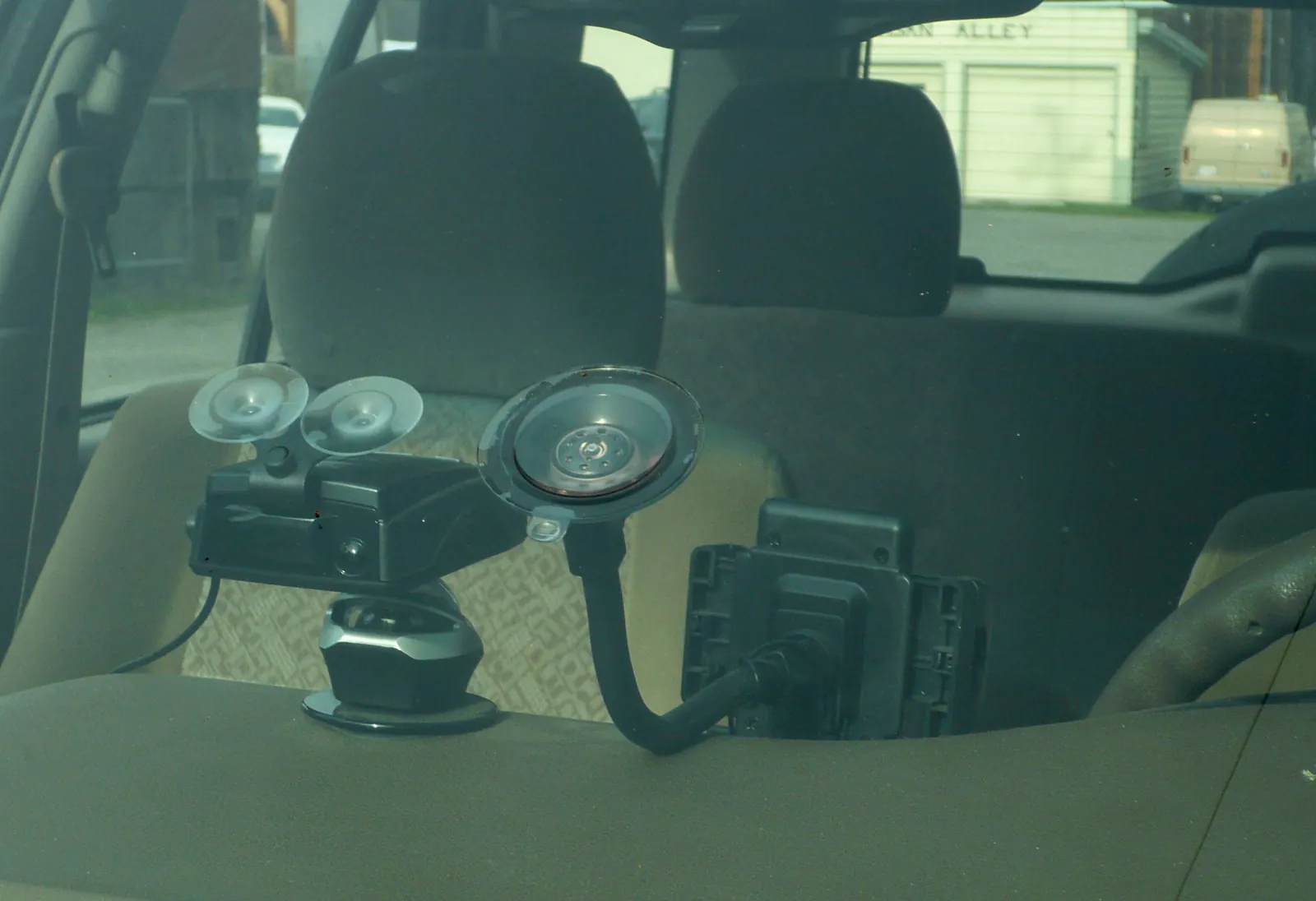
In practical terms, a compact camera mounted high, behind or beside the rear-view mirror, in an area the mirror already occupies, is the placement most installers start from. Keep the unit out of airbag zones, and do not run a cable across the driver’s field of view. A bulky suction-cup stack that sits lower on the glass is more likely to be a problem, both for visibility and for the way some statutes are written.
A smaller body is not a legal shield, but it is easier to place in the area behind the mirror. Confirm the current rules for each state you drive in, including any local variations, before you treat a mount as settled.
Habits that stay on the right side of caution
- Know whether your microphone is on. Turn it off if you do not need audio.
- Tell passengers that a camera may be recording, and use a visible notice if your situation or your state calls for one.
- Mount the camera so it does not block your view or sit in an airbag path. Re-check the mount after a windshield replacement.
- If you are stopped and asked about the camera, be calm and factual. This article cannot tell you what to say in every encounter.
- When you share footage with an insurer or the police, share a copy and keep the original.
Laws on both recording and mounting are written in general language and then applied to specific facts. A guide can point you to the statutes. It cannot certify that your camera, your mount, and your usual passengers are in the clear. If your situation is unusual — a commercial vehicle, a camera that records the cabin all day, or a dispute already underway — talk to a lawyer who practices in that state.
A dash cam is most useful when it is both legal to operate and still there when you need the file. A compact, carefully placed camera with a microphone you understand is a better plan than a larger unit you mounted in a hurry and never thought about again.